Research to Real World Issue 1
A Practical Guide to Doing AI Research
Research taste, problem formulation and decisive experiments, drawn from academia and industry R&D labs.
Here is an open secret about our field: almost nobody actually teaches you how to do research.
Universities teach you linear algebra, probability, and how to derive backprop on a whiteboard. Online courses teach you PyTorch, transformers, and how to wire up an agentic API in an afternoon.
And then one day, whether you’re starting a PhD, leading an applied AI team, or trying to invent a new product capability, someone hands you an open-ended problem and says: “Go figure out something novel.”
So you do what every slightly panicked researcher does at first: you open 37 arXiv tabs. You spin up a GPU. You create a folder with experiment_final_v3_ACTUALLY_FINAL.ipynb. Three months later, your GPU fans have sounded like a jet taking off from Schiphol, you’ve burned half a semester (or a quarter’s R&D budget), and a simple baseline still beats your fancy architecture by 2%.
Having done AI research across both academic labs (University of Cambridge, TU/e) and industrial R&D labs (Google Research, Philips Research), I’ve noticed something striking: the gap between people who spin their wheels and people who consistently produce work that matters (whether strong papers, real products, or defensible IP) rarely comes down to coding speed or math genius.
It comes down to three trainable skills: research taste, problem formulation, and decisive experimentation.
Here is the practical playbook I wish someone had handed me on Day 1.
1. Research Taste: Escape the “Method-in-Search-of-a-Problem” Graveyard
If you want to kill six months of your life quickly, follow this classic recipe:
Take Shiny New Architecture X (released on arXiv last Tuesday) + Apply to Dataset Y + Add one extra attention layer = Hope for magic.
We have all been tempted by this. It feels safe. It looks like research.
The problem? By the time your training run finishes, 47 other teams have done the exact same thing. In academia, it turns into an incremental +0.3% tweak that nobody remembers six months later. In industry, your VP of Engineering looks at your demo and politely asks: “Cool… why do we need this?”
Research taste is the ability to distinguish between noise and structural bottlenecks.
Good problems usually hide where messy reality breaks textbook assumptions:
- Textbook models assume clean, abundant labels → real-world sensors, audio, and biosignals are noisy, unlabeled, and drifted.
- Textbook benchmarks assume infinite datacenter GPUs → real devices have tiny batteries, strict latency caps, and privacy constraints.
- Textbook agent demos work on curated 3-step prompts → real workflows break silently on step 14 and need feedback loops to self-correct.
When you hunt for a real friction point first and bring original technical insight second, you land in the only quadrant that actually compounds:
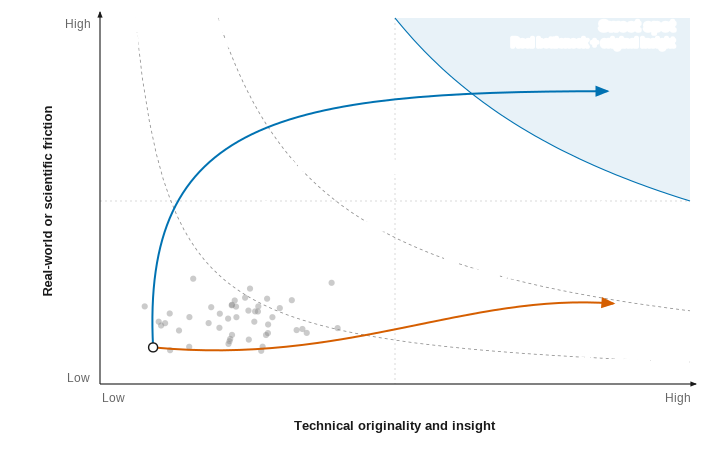
Taste check: Before you fall in love with an idea, ask: “If my method works as well as I hope, who actually cares, and what specific wall does it knock down for them?”
2. Problem Formulation: Close Your IDE on Week 1
Most smart technical people have the exact same habit: we open our code editor way too early.
Why? Because writing code feels productive. Watching progress bars move gives us dopamine. Sitting in front of a blank page trying to articulate a sharp hypothesis feels horribly uncomfortable, so we procrastinate by writing data loaders.
Here is the rule I push on everyone I work with: If you can’t explain your problem in 3 clear sentences over coffee, without hiding behind 6 Greek letters and an acronym you invented 10 minutes ago, you don’t have a problem yet. You have a vibe.
Before touching a GPU, write a brutal 1-page Problem Spec that answers four questions:
- What fails today, and why? Be painfully concrete. Not “multimodal AI is hard,” but “self-supervised audio/biosignal models collapse when deployed on unseen hardware due to sensor shift.”
- What hidden assumption is everyone else making? Great breakthroughs often come from flipping one unchallenged assumption (e.g., Do we actually need centralized data? Do we really need weight updates, or can an agent self-improve through structured feedback?).
- What is the “null hypothesis”? Why might a boring, already-existing method solve 80% of this?
- What does the “Future Headline” look like? Write a 4-sentence mock abstract (or an internal product memo or patent claim) before you run experiment #1. If the future headline sounds boring even when you assume 100% success, stop immediately and reframe the problem.
Fixing a fuzzy problem in a Google Doc takes two hours. Fixing a fuzzy problem after two months of experiments takes therapy.
3. Decisive Experiments: Kill Your Darlings Before They Kill Your Quarter
Once you have a sharp hypothesis, the next trap is confirmation-driven experimentation.
You build a complex pipeline, run 50 sweeps, cherry-pick the one seed that looks promising, and convince yourself you’re “almost there.” Six weeks later, you finally run a proper baseline and discover a 15-line logistic regression or a zero-shot foundation model quietly beats your masterpiece.
Experienced researchers invert this completely. They don’t run experiments to prove they are right. They run Decisive Experiments designed to falsify their riskiest assumption as cheaply and brutally as possible.
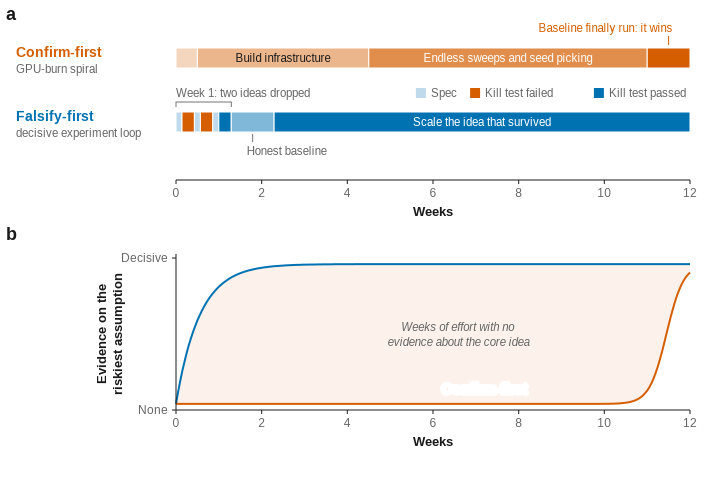
Two rules that immediately upgrade your experimental rigor:
- Run the 48-hour “Kill Test”: Ask, “What is the single assumption that, if false, renders this entire project pointless?” Test that on a tiny subset or synthetic toy problem before writing a single line of fancy infrastructure.
- Treat baselines like first-class citizens: Give your dumbest, simplest baseline the exact same tuning love you give your proposed method. If the simple baseline wins, celebrate: you either just saved yourself a wasted quarter, or you discovered a much cleaner insight worth sharing. (In research, truth beats cleverness every single time.)
4. Think Beyond the Code: One Research Engine, Three Durable Outputs
Here is my favorite mindset shift from living in both academia and industrial R&D: stop thinking of “academic research” and “product R&D” as two different universes.
Too many PhDs treat research purely as a game of pleasing anonymous reviewers. Too many engineers treat R&D as stitching together yesterday’s open-source repos.
When you master the underlying research operating system (Taste → Sharp Problem → Decisive Evidence), you create something far more durable: original insight backed by proof. From that exact same engine, three different assets naturally emerge depending on your goal:
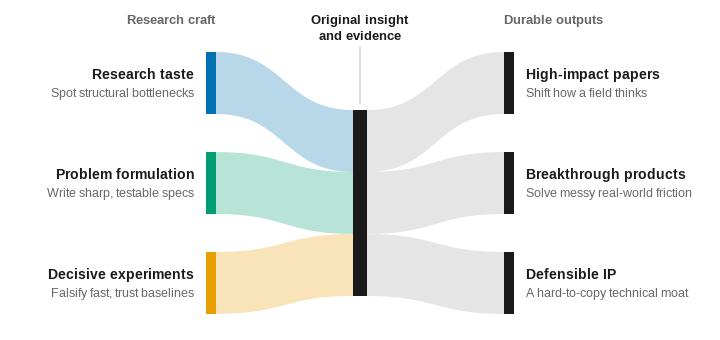
When your work sits at that center hub, you stop chasing trends and start building things that last.
Your Monday-Morning Research Gut-Check
Next time you sit down to work on an AI project, pause for 10 minutes before launching another training job and ask:
- What real-world or scientific bottleneck am I actually attacking?
- Can I state my hypothesis in 3 plain sentences without jargon?
- What is the single riskiest assumption that could break this?
- What 48-hour experiment would decisively falsify it?
- If I tune the simplest baseline honestly, does my idea still earn its complexity?
Good research isn’t magic, and it isn’t reserved for a lucky few labs. It’s a craft, and once you learn the operating system, it stops feeling like gambling with GPUs and starts becoming deeply fun.
I’d love to hear from you: what’s the most painful “simple baseline beat my fancy model” moment you’ve ever had? Or where do you find yourself getting stuck most often right now? Tell me in the comments on LinkedIn or by email.